STATE-SPONSORED REPRESSION AND THE WAR ON DRUGS
Two years ago today, 43 students of la Escuela Normal Raúl Isidro Burgos, also known as the Normal Rural de Ayotzinapa—a residential college for peasant farmers studying to become teachers serving in their own rural communities—disappeared in Iguala, Guerrero.Rural normal colleges, such as the Normal Rural de Ayotzinapa, are a legacy of the Mexican Revolution, and are known for activism, defending human rights, opposing the privatization of education, and criticizing the state.
The story leading up to the incident and the fate of the missing 43 is still not clear. There has been virtually no movement on the government’s behalf, and a final report by the Inter-American Commission on Human Rights has refuted the Mexican government’s “official” version of the events.
This issue of the Monthly Mosaic will share the Ayotzinapa victims’ story and demonstrate ways your chapter can demand justice.
Do an SSDP DARE from the Ayotzinapa Organizing Guide, and get 10 points on the SSDP Chapter Activity Tracker)! You can also do any of this month’s DAREs on the 26th of any month to raise awareness about the tragedy at Ayotzinapa.
WHAT HAPPENED TO THE MISSING AYOTZINAPA STUDENTS?
On September 26th, 2014, five buses of Ayotzinapa students were attacked in and around the city of Iguala, Guerrero. That night, six people were killed, and 43 students were taken and put into police cars. To this day, the truth of the events of that night and the fate of the 43 are unknown. Unfortunately, Ayotzinapa is not the first or only case of forced disappearances to which the Mexican government has been tied. On July 31st, the Inter-American Commission on Human Rights approved the Mecanismo de Seguimiento, one of the demands of the families of Ayotzinapa, to continue an independent investigation into the case. A previous independent international investigation by the Grupo Interdisciplinario de Expertos Independientes (GIEI) was blocked by the Mexican government after the group publicly contradicted official reports. In their second report, “Informe Ayotzinapa II,” the GIEI wrote that their expulsion only strengthens their lack of confidence in the institutions of Mexico’s federal government. They argue that if the federal government can, in the presence of an internationally supervised body, still act with such levels of impunity, omission, and intentional interference and delay, it is indispensable to continue with a mechanism of international oversight until justice and truth are reached. Meanwhile, the Argentine Forensic Anthropology Team, a non-profit scientific organization that applies forensic sciences to the investigation of human rights violations, uncovered 60 mass graves while searching for the disappeared students. However, of the remains identified, none belonged to the 43 missing Ayotzinapa students.Tomás Zerón, the head of the criminal investigation agency similar to the FBI, recently resigned in connection to the Ayotzinapa disappearances. He has been accused by multiple reports of falsifying the little forensic evidence available—a piece of bone—and tying the evidence to a grave site where the Mexican government claims the students were buried. The GIEI report would later reveal that it was unlikely the grave site was the final destination for any of the victims.
The victims’ families are still campaigning to find out the truth, but with so much confusion and obfuscation on the part of the government, it is highly doubtful there will be any resolution for either the families or the people of Mexico. Disappearances continue to rise, the drug war rages on, and another anniversary comes and goes.
The one positive is that the work of these international teams and the continued resilience of the families has brought much-needed publicity to the larger human rights crisis in Mexico.
SSDP DEMANDS JUSTICE FOR AYOTZINAPA VICTIMS.
To honor this important issue, SSDP released an Ayotzinapa Organizing Guide for students around the world who want to get involved.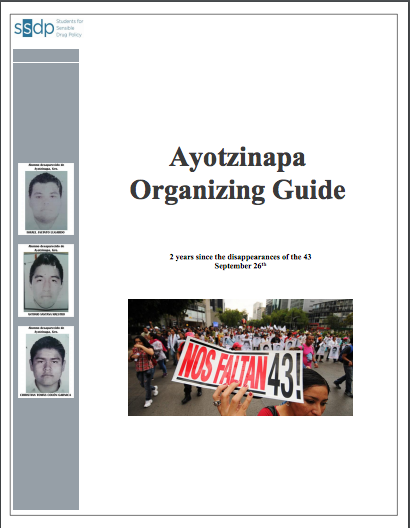
Ayotzinapa Organizing Guide
Meanwhile, several students, including SSDPers have been active in the fight for justice, since the disappearances first occurred.
A month after the disappearances, a student at the University of San Francisco reached out to the school’s president, convincing the president to release a letter taking a public stand against violence.
In November of the same year, two students from San Diego City College organized a march to the Mexican Consulate on the International Day of Action, facilitating transnational activism by bringing together 400 students from local San Diego and Tijuana colleges.
The University of California-Berkeley chapter has been particularly vociferous, hosting monthly vigils on the 26th of every month, displaying 43 chairs to commemorate the lives of the students lost in the Ayotzinapa disappearances. Each month, students and members of the community come together to remember the lives of those who continue to seek justice from Mexican government officials.

Students at the University of California Berkeley raise public awareness about the disappearances.
UC Berkeley chapter members have also been working with the Caravana Contra La Represión En México. The caravan’s objectives are to support Mexican social movements and denounce government repression, including but not limited to disappearances, assassinations, political prisoners, land grabs, and femicides.
The caravan will be stopping in various cities across California, Illinois, and New York to raise awareness for Ayotzinapa and eight other social movements, and will make Bay Area appearances November 3rd to speak to students about the issues facing Mexican Citizens concerning the War on Drugs and drug crime. For more information, stay in touch with the caravan via Facebook or their website.
LEARN MORE.
These additional resources can help you learn more about the crisis in Mexico, and what you can do to help.- Ayotzinapa Organizing Guide
- Call to Action: Demand Justice for Ayotzinapa Victims and an End to State-Sponsored Repression
- Why Hasn’t There been Any Justice for the Victims of Ayotzinapa?
- Ayotzinapa: How Heroin Trafficking, Mining, and US Foreign Policy Played a Role
TAKE ACTION.
Do an SSDP DARE from the Ayotzinapa Organizing Guide, and get 10 points on the SSDP Chapter Activity Tracker)! Remember, you can do any of these DAREs on the 26th of any month to raise awareness about Ayotzinapa.- Share the Monthly Mosaic on Facebook or Twitter using #MonthlyMosaic.
- Demonstrate in front of Mexican Consulate or Mexican Embassy, if there is one in your city, while remaining conscious of those who need to access those resources. Our goal is to stand in solidarity with the families, denounce the corrupt state, and demand an end to US policies that are causes of these disappearances.
- Organize a march, demonstration, or vigil in another public place where your action can receive more attention and spread greater awareness.
- Organize campus demonstrations to bring awareness to the issue. One powerful idea is to display empty desks with the faces of the 43 disappeared students symbolizing the repression against students in México.
- Create an art installation to spread the message (e.g. sidewalk paintings or murals, sidewalk galleries, etc.). Sometimes these can be more impactful than a sidewalk demonstration or a march, making a greater and longer-lasting impression.
- Get your university administration to stand in solidarity with the victims of Ayotzinapa and their families by publishing a statement, divesting funds, or another tangible action.
- Lobby your elected representatives to support the reduction of funds to Mexican security forces.
- Publish an article/column/blog post about what has happened in Ayotzinapa, commemorating the two years since the disappearances, and addressing the wider human rights violations and increased disappearances in Mexico since the onset of the drug war.
GET INVOLVED.
- Have a suggestion for a topic or want to see your chapter featured in the Monthly Mosaic? Submit your ideas, or email Frances at frances@ssdp.org to learn more.
- Get involved with SSDP’s Diversity Awareness, Response and Education committee.
- Know someone you think would find this interesting? Forward this email on and have them subscribe to the Monthly Mosaic.
CONTRIBUTIONS.
Each Monthly Mosaic is edited by Frances Fu and Kat Murti. This issue also features contributions by Jacki Moreira.Each month, SSDP’s Diversity, Awareness, Reflection and Education (DARE) committee publishes the Monthly Mosaic, a newsletter dedicated to exploring intersectionality and the War on Drugs. Previous issues have covered topics such as domestic violence, trans awareness, Black Lives Matter, and women’s unique experiences with the drug war.
The DARE committee strives to promote inclusivity within the SSDP network, and facilitate collaboration and engagement with presently underrepresented perspectives, individuals, and movements. In order to ensure that the Monthly Mosaic more intentionally and meaningfully reflects these values, the DARE committee is pleased to invite members of our student and alumni network to submit ideas for upcoming issues.
If you have any questions, please contact Frances at frances@ssdp.org. We look forward to reading your submissions!