The days are quickly ticking down to November 8th, and we’re all feeling the pressure to make sure we’re informed, registered to vote, and know who and what we’ll be voting for.
The U.S. is gearing up to chose our next president, cannabis initiatives are on the ballot in nine states, and, of course, there are several down ballot elections each of us will be voting in.
It’s also important to remember just how many Americans can’t vote, many times because of prior drug war convictions.
We hope this issue of the Monthly Mosaic serves as a helpful guide as you contemplate your ballot, and that it will inspire you to consider some of the ways in which the drug war has impacted our electoral system.
Do an SSDP DARE, and get 10 points on the SSDP Chapter Activity Tracker! Don’t know what that is? Email Frances at frances@ssdp.org.
BALLOT INITIATIVES FOR TOR THE 2016 ELECTION
The November 8th election will extend far beyond who will be the next President of the United States. This year, a combination of ballot initiatives on marijuana, tobacco, and more will be presented to voters, totaling 163 ballot measures overall.The 2016 electorate will be the most diverse in U.S. history, and that is likely to impact election results. 82 million Americans live in one of the nine states that have a marijuana initiative on the ballot this year, and the results of these elections will almost certainly affect the rest of the country’s efforts to end cannabis prohibition once and for all. Millennials—the vast majority of whom, across parties, support legalizing marijuana use—will be crucial to passing these initiatives, which is why it is imperative our chapters do their part to get out the vote.

Even if all nine initiatives do pass, legalization alone will not be enough to alleviate the harms of decades of marijuana prohibition policies. As we’ve seen in Colorado, racial disparities in the enforcement of illicit marijuana activities are not immediately eliminated through successful legalization initiatives. As criminal penalties are reformed and new opportunities emerge within the legal marijuana industry, it is critical that policy activists assert the need to have inclusive policies for marijuana industry licensing and enforcement of new laws.
In Oklahoma, voters will have the chance to decide on criminal justice reform issues addressed by State Questions 780 & 781. SQ 780 resembles California’s Proposition 47, and would change simple drug possession crimes from felonies to misdemeanors, while SQ 781 directs the costs savings from SQ 780 to a state fund that would allocate money to counties to fund mental health and substance use disorder services.

THE CANDIDATES ON DRUG POLICY
This year’s election has been contentious, with candidates under intense scrutiny on all the issues. Here is a brief overview of where the four most notable candidates stand on drug policy…Gary Johnson (Libertarian)
- Johnson’s official stance on drug policy is to end the War on Drugs, which he considers a key issue in his platform.
- In 2000, as Governor of New Mexico, Johnson signed the National Governors Association policy, which increased federal funding for all aspects of Drug War.
- In 2001, he co-sponsored the Western Governors’ Association resolution, which held that states, not the federal government, should make drug policy.
- Earlier in 2001, Johnson proposed & signed into law five bills which expanded treatment services, created legal protections for syringe sales, and restored voting rights for formerly incarcerated individuals.
- Key talking points:
- Marijuana is safer than alcohol.
- 75% of border violence with Mexico is due to drugs, and tens of thousands have died.
- The American people want to legalize; it’s incumbents who don’t.
- We have the highest incarceration rate of any country in the world, and should legalize marijuana instead of arresting millions and spending billions.
- Drugs should be treated as a health issue rather than a criminal justice issue.
- Drug policy today parallels Prohibition in the 1920s.
- By managing marijuana like alcohol and tobacco—regulating, taxing and enforcing its lawful use—America will be better off.
- Drug use is up billions of dollars spent on failed drug war policies.
- States should make drug policy, not feds.
- Harm-reduction is key, and addicts should be able to get prescription heroin & methadone at local pharmacies. He also supports the Swiss heroin maintenance model.
- As First Lady, Hillary Clinton pushed for the largest crime bill in the history of the United States: the Violent Crime Control and Law Enforcement Act. Under this law, drug users were more easily incarcerated and more likely to serve long sentences.
- Under Hillary Clinton’s leadership, the State Department hired American defense contractors to take part in the Mexican Drug War and sold billions worth of weapons to Mexico — leading it to become one of the world’s top purchasers of U.S. military arms and equipment.
- Clinton co-sponsored legislation to help alleviate the 100-to-1 sentencing disparity for crack vs. powder cocaine.
- Key talking points:
- $1B per year to help states with opioid epidemic, in part by equipping police officers and firefighters with Narcan and training them to use it.
- We have to move away from treating the use of drugs as a crime, and instead move it to where it belongs, as a health issue.
- We need to divert more people from the criminal justice system into drug courts, into treatment, and recovery.
- Supports cracking down on doctors prescribing opioid medications.
- Stop imprisoning marijuana users.
- Reduce sentencing disparity for crack, but not retroactively.
- Supports allowing states to adopt their own marijuana policies and has said she would not want the federal government to interfere in them.
- She wants to see what happens with state marijuana legalization prior to taking a position in support or opposition to federal legalization.
- Clinton supports reclassifying marijuana from Schedule I to Schedule II to remove barriers to researching its medical benefits.
- Called for putting more officers on the streets, with greater emphasis on community policing to build trust while fighting crime, as well as new support for specialized drug courts & juvenile programs.
- Involved parents are the most influential in reducing teen drug use.
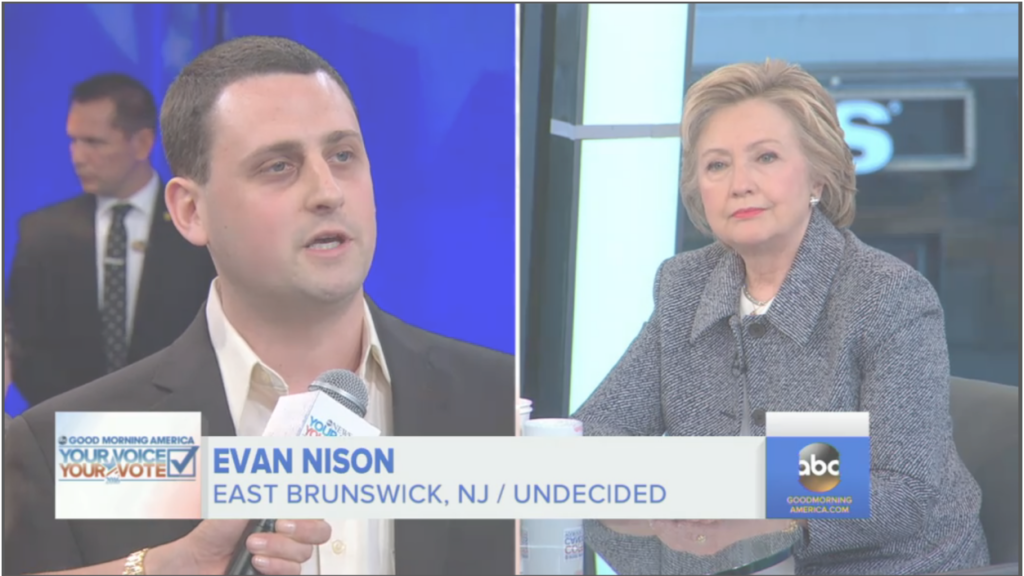
WATCH: SSDP Board Member Evan Nison asks Hillary Clinton on ABC News whether she would vote for marijuana legalization if it were on the ballot in her state.
Donald Trump (Republican)
- Trump is a lifelong teetotaler whose brother died of alcoholism. He claims that, to this day, he has never drank alcohol, smoked, or done any other drugs.
- His position has changed over the last 20 years. In 1990 Donald Trump was in favor of legalizing all drugs. Now, Trump believes medical marijuana should be legal, but recreational marijuana should not be legalized, though he respects states’ right to do so.
- In 2008, he gave a second chance to Miss USA who got caught with drugs, stating “I do not tolerate or condone that kind of out-of-control behavior…I do believe in giving second chances.”
- Key talking points:
- Study legalization, but don’t legalize now.
- Yes to medical marijuana; otherwise, decide state by state.
- Has advocated building a wall across the Mexican border to prevent drugs “from pouring into our communities.”
- Stein supports legalizing and regulating marijuana for medical and adult use nationwide.
- Key talking points:
- Replace drug prohibition with harm reduction.
- The war on drugs is racist.
- End the racist war on drugs and school-to-prison pipeline.
- Transform from a criminal drug system to a public health system.
- Marijuana is dangerous because it’s illegal, not vice-versa.
- Bring marijuana sales under a legal regulatory framework.
THE WAR ON DRUGS PREVENTS MARGINALIZED COMMUNITIES FROM VOTING
The War on Drugs has been one of the main reasons for the rapid rate of increase in America’s prison population. Almost two million people fill U.S. prisons and jails, and those who do are disproportionately people of color.Voting rights for persons convicted of felonies differ greatly from state to state. Only two states allow incarcerated people to vote while in prison, and only 14 automatically restore voting rights as soon as an individual is released. Meanwhile, in 10 states, the formerly incarcerated can permanently lose the right to vote. Within each state the restriction of voting rights may be contingent upon the type of crime, may be reinstated upon completion of parole, or may be restored automatically following completion of a sentence.
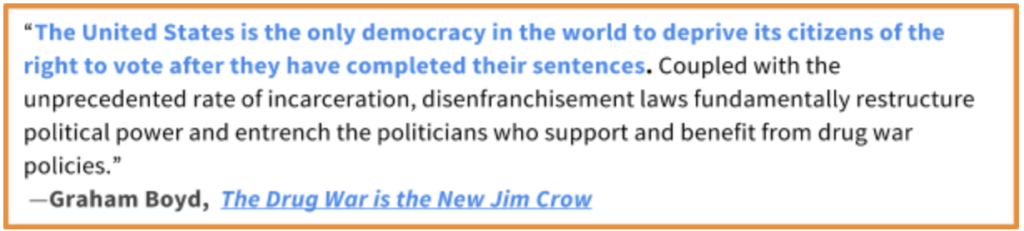
This is especially important to consider in swing states. In Florida, for example, many nonviolent drug possession offenses are counted as felonies, and even drug-offenders who never faced any time in jail can lose their right to vote permanently. 31% of all African-American men in the state were barred from voting in the 2000 presidential election, which could have significantly changed the outcome.
There have been several attempts at the state and local levels to reinstate voting rights for individuals convicted of a felony over the decades.
In 1976, California’s constitution was amended to expand voting rights and end permanent disenfranchisement of people with felony convictions. Anyone who is a California resident over the age of 18 and not currently serving a sentence for a felony or on parole for a felony could vote. On September 28th of this year, California Governor Jerry Brown signed into law AB2466- Voting Rights Clarification, a bill that expands voting rights for people with felony convictions by ensuring that people currently imprisoned in county jail do not lose their voting rights.
Earlier this year in February, the Maryland General Assembly successfully established the restoration of voting rights for individuals following the completion of their term of incarceration.
However, when Virginia Governor Terry McAuliffe issued an executive order in August restoring voting rights to people convicted of a felony who had completed their sentence, andtheir parole or probation period, the Virginia Supreme Court overturned his action.
The Colorado Criminal Justice Reform Coalition’s “Can I Vote?” program serves as an excellent example of what advocacy looks like at the local level. The CCJRC is the state’s only civic engagement program focusing exclusively on people with criminal records. The coalition works to educate formerly incarcerated people, state officials, and community members about the “nuances of voting eligibility for people with criminal histories.”
LEARN MORE: For the full list of actions on voting rights for persons with felony convictions, check out the National Conference of State Legislatures’ information page.
TAKE ACTION.
Do an SSDP DARE and get 10 points on the SSDP Chapter Activity Tracker!- Share the Monthly Mosaic on Facebook or Twitter using #MonthlyMosaic.
- Register people to vote – you get 1 point for each voter registered!
- Do your part to end cannabis prohibition by making phone calls to voters and educating them about sensible drug policy.
- Don’t forget to GO VOTE.
GET INVOLVED.
- Have a suggestion for a topic or want to see your chapter featured in the Monthly Mosaic? Submit your ideas, or email Frances at frances@ssdp.org to learn more.
- Get involved with SSDP’s Diversity Awareness, Response and Education committee.
- Know someone you think would find this interesting? Forward this email on and have them subscribe to the Monthly Mosaic.
CONTRIBUTIONS.
Each Monthly Mosaic is edited by Frances Fu and Kat Murti. This issue also features contributions by Miranda Gottlieb, Rachel Wissner, and Sarah Merrigan.Each month, SSDP’s Diversity, Awareness, Reflection and Education (DARE) committee publishes the Monthly Mosaic, a newsletter dedicated to exploring intersectionality and the War on Drugs. Previous issues have covered topics such as domestic violence, trans awareness, Black Lives Matter, and women’s unique experiences with the drug war.
The DARE committee strives to promote inclusivity within the SSDP network, and facilitate collaboration and engagement with presently underrepresented perspectives, individuals, and movements. In order to ensure that the Monthly Mosaic more intentionally and meaningfully reflects these values, the DARE committee is pleased to invite members of our student and alumni network to submit ideas for upcoming issues.
If you have any questions, please contact Frances at frances@ssdp.org. We look forward to reading your submissions!